
Jon and I were the same age (15). A couple of months before I was punched in the face, he and his family moved into the big fancy new house about two blocks from our house. It was a one-punch fight. Being punched in the face hurts. I deserved it and apologized once I got back on my feet.
Jon walked past me on the bus wearing a long, flamboyant scarf. I stood up and pulled the scarf hard. He calmly turned around and punched me in the face. It was then I realized I was way overmatched. He helped me up, and I apologized. From then on we were not friends but friendly.
Some teenage boys (me, then) can be territorial. Whether the cause is hormones, or whatever, being punched in the face helped me learn my primal need to defend my territory was not so much needed in today’s world. I was lucky guns were not involved.
Sometimes violence is narrowly avoided but the underlying issues still need to be addressed. A couple of years after college, I was a busy Unemployment Claims Representative in the Minneapolis Unemployment office determining eligibility to collect unemployment benefits.
Jim (I do not remember his real name but he had a real name) looked every bit like the unkempt, homeless, 40-year-old, white man he was. Six months earlier he was let go from his job as a part-time dishwasher because his boss’s nephew wanted a summer job.
After reviewing statements from both he and the employer, I determined he was eligible for about $20 a week for up to thirteen months. At first, he just stared at me for like 30 seconds. Then he reached out and in one motion swept everything (pictures, papers, a pencil holder, box of paper clips, a cup of water and the like) off my desk crashing onto the hard floor. Then he screamed something like, “I do not want to be homeless anymore” at which time he pulled out a knife and pointed it very threateningly about a foot from my face. He was crying and his hand was shaking.
We had drills about this sort of situation. A coworker called the police immediately. My job was to be calm for the several minutes it would take the police to arrive. Deescalate. Well, all I could think of was to ask why he was so upset with being granted Unemployment benefits.
Before the police arrived he put the knife down, apologized and sat down defeated. The gist was he had been homeless since spring and winter was coming fast. There was a shelter he was eligible for if he could show he was not eligible for other benefits. He had spent weeks going from agency to agency getting forms signed saying he was not eligible for benefits and thus eligible to live at the shelter.
From Jim’s point of view, me signing the form saying he was eligible for even these paltry Unemployment benefits were condemning him to try to survive outside in a Minnesota winter without shelter. The police escorted him away in handcuffs and that was the last I heard of him. I was never asked to testify or submit any statements. I do not know his fate.
Violence is never the answer but frustration and fear can motivate desperate people to do violent things. Sometimes when I hear about violence on the news, I am reminded there is almost always more to the story than the act of violence itself.
My older brother John completed basic training and was home on leave a couple of days after my high school graduation (June 1970). We were standing in the backyard shooting the breeze when he looked around and lowered his voice making sure nobody else could hear. He then gave me the following advice.
“When you kick somebody in the head. Make sure you knock them out. If you do not knock them out, they will get up and likely kill you.” He was not talking figuratively because I asked. He was very serious. He proceeded to demonstrate how to kick someone in the head and knock them out.
I sometimes get frustrated but I never was frustrated enough to want to kick someone in the head. Yet, I think there is an underlying truth in my brother’s observation: When an action you take hurts someone, they will be highly motivated to hurt you back.
Violence causes more problems than it solves. Violence is not acceptable, whether or not it would be effective in resolving an issue. Yet there are issues that need to be resolved. Violence is usually not a rational response but in the heat of a tense situation, rational is hard to come by.
My best friend, HP, in high school, was of Japanese descent. We were at a dance in the basement of Har Mar Mall. Some jerk and a couple of his friends threatened HP, saying they did not like foreigners dancing with the girls. My older brother and a couple of his friends told me and HP to keep dancing. They would handle the problem. We kept dancing and violence happened to the people who harassed us. A non-violent method of resolving the issue would have been better.
Violence is almost never justified. Violence almost never solves the issue which led up to the violence in the first place. Nevertheless, violence exists. Condemning violence is easy. Understanding what led up to the violence and how to resolve the issues is very much, not easy.

 In the fourth or fifth grade, as a geography lesson, we drew flags from the countries of our nationality. I drew Swedish and Norwegian flags. Mom’s side, Swedish. Dad’s side, Norweigan. Over the years, my guess is I have been asked my nationality hundreds of times. Maybe thousands of times.
  Let us pretend a kid wants me to play trucks. I probably would politely say no because crawling around in the sand takes a bigger commitment at my age than I am willing to commit to. I can make engine noises and push a truck with the best of them. However, crawling around in the sand actually would be tough.
  About a month ago, mid-November 2019, my Urologist called saying I likely had early-stage kidney cancer. Since then appointments, Christmas shopping, and surgery. My right kidney, along with a cancerous tumor was removed.
 Going back to college as a retiree was all good until it was sorta not. I was hanging out with the cool kids, Wow look at me, the old person in a class of 20ish-year-olds. I am riding the bus, studying, reading, writing papers, joining in class discussions. It kinda made me feel special.

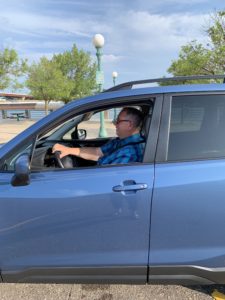 We drove 3,400 miles over 11 days from St Paul MN to where the Mississippi River dumps into the Gulf of Mexico and back again. The Great River Road route is a designated zig-zag of mostly two-lane state or county roads going through rural mid-America. Very little freeway. Some town roads. Thirteen miles was a very narrow, harrowing one-lane gravel road.